
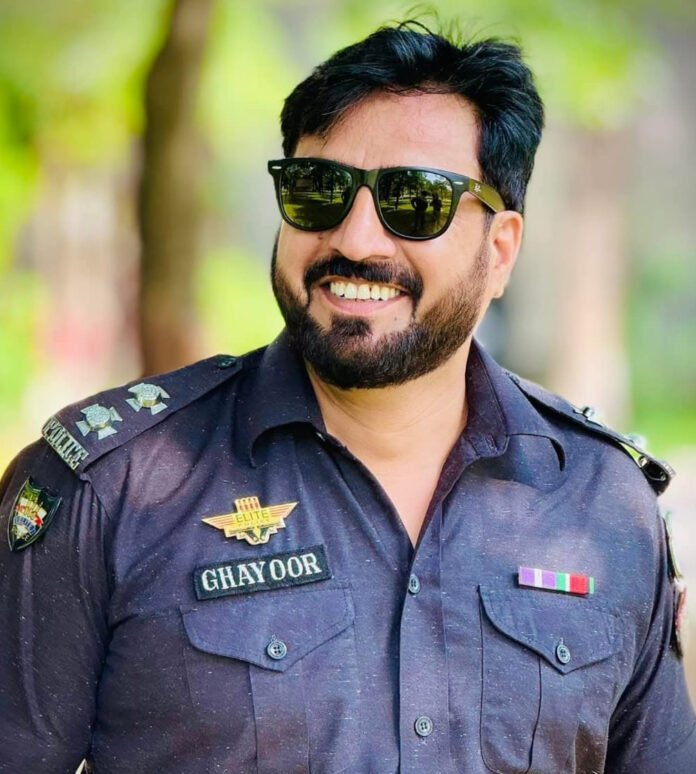
Two separate incidents in Rawalpindi and Lahore have raised serious questions about law enforcement, public safety and the responsibility of police officials. In Rawalpindi, CCD Sub-Inspector Adnan Gh you are martyred while pursuing armed criminals, while in Lahore, a young motorcyclist named Zain died after reportedly suffering a serious head injury during an attempt by a traffic warden to stop him.
In Rawalpindi, police said CCD Sub-Inspector Adnan Gh you was pursuing a wanted criminal when the suspect allegedly opened fire. The officer sustained a bullet wound to the head and was critically injured. Despite receiving medical attention, he succumbed to his injuries and was martyred while performing his duty.
The incident took place on September 2, 2026, within the jurisdiction of Chaklala Police Station. Senior police officials reached the scene soon after the incident and an investigation was launched. CCTV footage of the incident has also emerged, reportedly showing the officer confronting the suspected robber during the pursuit.
According to police, the suspect, identified as Umar Khan alias Sheena, was later confronted again during the continuing operation in the Dhok Chaudhrian area. A gun battle reportedly took place, in which the wanted suspect was also killed.
The martyrdom of Sub-Inspector Adnan Gh you has triggered grief among his family, colleagues and the police department. Senior officials have paid tribute to the officer, describing his sacrifice as an example of courage and commitment to duty. The incident once again highlights the dangers faced by police personnel while confronting armed and wanted criminals.
Meanwhile, a separate and tragic incident in Lahore has raised a different set of questions about the use of authority on the roads.
According to reports, young motorcyclist Muhammad Zain was travelling through Shadman on August 26 when a traffic warden allegedly attempted to stop him. CCTV footage reportedly shows the warden moving into the motorcycle’s path, after which the motorcycle collided and Zain fell to the ground. He sustained a serious head injury and remained under treatment at Services Hospital for five days before eventually passing away.
Zain’s family has demanded justice and a transparent investigation into the circumstances surrounding his death. His mother also submitted an application to the Lahore DIG Operations, seeking action and accountability. Reports further state that an overspeeding case was registered against Zain, despite his subsequent death from injuries sustained in the incident.
Authorities have taken notice of the matter, and the traffic warden involved has reportedly been suspended over allegations of negligence and carelessness.
The two incidents are different in nature and should not be treated as identical cases. In Rawalpindi, a police officer lost his life while pursuing suspected criminals; in Lahore, a civilian lost his life following an incident involving a traffic enforcement officer. However, both cases raise one fundamental question: how should the power of the state be exercised while protecting human life?
Police officers risk their lives every day to protect citizens and confront criminals, and the sacrifice of officers like Adnan Gh you deserves respect. At the same time, ordinary citizens also have the right to expect that law enforcement officials will enforce the law without unnecessarily putting their lives at risk.
The answer cannot simply be silence, suspension or another case file. Every allegation must be investigated fairly and transparently, responsibility must be established according to law, and lessons must be learned to prevent similar tragedies.
Because the real strength of law enforcement is not merely the power to stop people—it is the ability to protect lives while upholding the law.