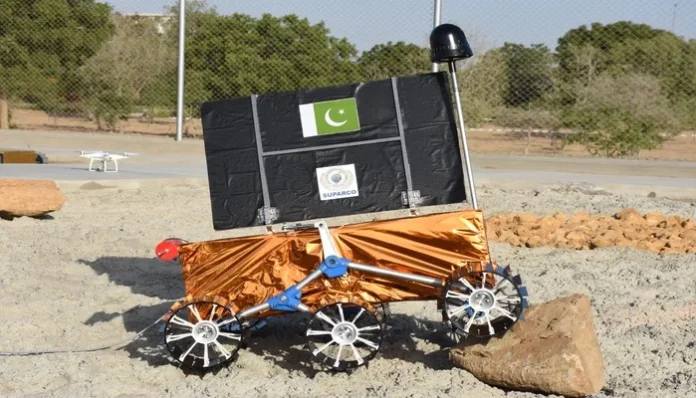


Islamabad: Pakistan has taken another step forward in its space exploration programme with the selection of “Jinnah-1” as the name of the country’s first indigenous lunar rover.
The name was reportedly proposed by 17-year-old Tayyab Kareem from Bahawalnagar and selected from thousands of entries submitted during a nationwide naming competition. The choice of “Jinnah-1” links Pakistan’s first lunar exploration vehicle with the country’s founder, Quaid-e-Azam Muhammad Ali Jinnah.
The lunar rover is being developed by the Space and Upper Atmosphere Research Commission (SUPARCO) and is scheduled to travel to the Moon aboard China’s Chang’e-8 mission. SUPARCO says the mission is currently planned for 2028, although some reports have referred to 2029.
According to SUPARCO, the rover will weigh around 35 kilograms and is expected to land near the lunar south pole, an area considered particularly important for scientific research and future human exploration. The mission will involve studying lunar soil, mapping the lunar surface and testing technologies that could support future lunar and planetary missions.
Pakistan’s participation in Chang’e-8 follows a Memorandum of Understanding signed between SUPARCO and the China National Space Administration in February 2025. Pakistani scientists and engineers have been involved in designing, manufacturing, assembling, integrating and testing the rover, while Pakistani scientists are expected to control and operate it from Earth once deployed.
The mission is also linked to the broader International Lunar Research Station initiative, which aims to develop technologies and scientific capabilities for long-term exploration of the Moon.
The selection of a name proposed by a young student adds a human dimension to the programme. It shows that Pakistan’s space ambitions are capturing the imagination of a new generation and allowing young people to become part of a national scientific milestone.
When “Jinnah-1” eventually reaches the lunar surface, it will not only represent a major step for Pakistan’s space programme but also carry the hopes and aspirations of a country looking to expand its role in international space exploration.