
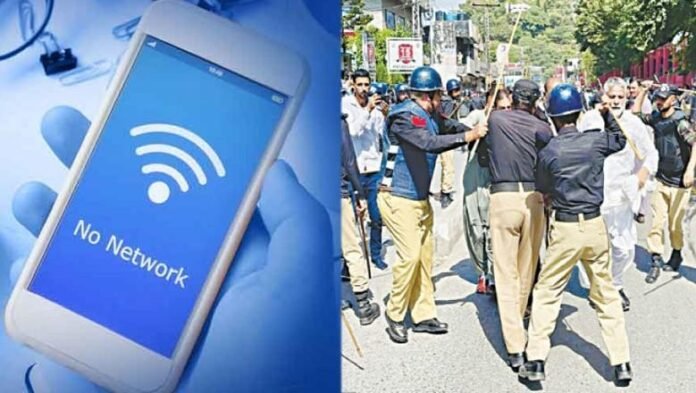
The Azad Jammu and Kashmir government has decided to begin the phased restoration of internet services in eight districts from August 31, following a prolonged suspension of connectivity in several areas.
The restoration, however, will not be uniform across all locations. In some areas, internet access will initially be limited to educational institutions and banks, while selected areas will also receive DSL as well as 3G and 4G mobile internet services.
The AJK government has formally approached the federal Ministry of Interior with a request for the restoration of internet services. According to a notification issued by the AJK Home Department, connectivity will be restored gradually in different districts and areas under specific conditions.
In different parts of the Muzaffarabad Division, DSL and 3G/4G services will be restored in accordance with the approved arrangements. In Muzaffarabad district, however, only DSL connectivity will initially be available to educational institutions and banks.
Limited DSL services will also be restored for educational institutions and banks in Bagh city and Dhirkot. In Haveli Kahuta, both DSL and 3G/4G internet services will be restored.
Residents of Mirpur and Bhimber districts will have access to DSL internet services across the two districts. In Kotli, DSL connectivity will be restored for educational institutions and banks.
However, several areas will remain without internet access during this phase. DSL services will not be restored in Sehnsa, Sarsawa, Baloch and Tatta Pani, while internet services will remain suspended for the time being in Rawalakot and Sudhanoti.
The government has also introduced conditions for the restoration of internet services. Heads of educational institutions and officials responsible for bank branches have been directed to submit affidavits.
Under these affidavits, the institutions will assure the authorities that their internet connections will not be used against state interests, national security or public order.
The government has also linked any future decision to suspend internet services to the behaviour and activities of social media users. This means that the authorities may review internet access depending on how social media platforms are used in the future.
The development comes at a time when internet connectivity has become an essential part of everyday life—not only for communication, but also for education, banking, business, employment and access to information.
The key question now is whether the phased restoration will provide meaningful relief to residents and when the remaining areas will finally receive full internet connectivity.