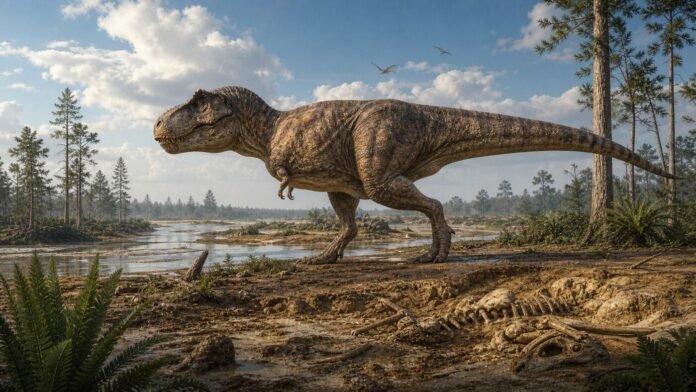


Scientists have made an extraordinary discovery in the U.S. state of North Dakota — a series of four consecutive footprints believed to have been left by an adult Tyrannosaurus rex approximately 66.5 million years ago.
The discovery is particularly important because, rather than finding just a single isolated footprint, researchers have identified a short but continuous trackway showing the sequence of an adult T. rex taking several steps. The tracks provide scientists with a rare opportunity to study not only the size of the giant predator, but also how it moved across the landscape.
The trackway was found in the famous Hell Creek Formation of southwestern North Dakota, a geological region renowned for fossils from the final stages of the dinosaur era. The trackway stretches for roughly 23 feet, or about 7 meters, and contains four clearly identifiable three-toed footprints — two from the left foot and two from the right.
Each footprint is approximately 3 feet, or 0.9 meters, long, illustrating the enormous size of the animal that left them behind. The distance between successive footprints is around 13 feet, allowing researchers to estimate the animal’s walking speed.
Based on the spacing and dimensions of the tracks, scientists estimate that this particular T. rex was moving at approximately 3.5 to 4.5 miles per hour, or roughly 5.6 to 7.2 kilometers per hour.
That means the animal was apparently not sprinting after prey. Instead, it was moving at a relatively brisk walking pace through its ancient environment.
This distinction is scientifically important. Fossil bones can tell researchers about the anatomy and physical structure of an extinct animal, but footprints can reveal something different: how that animal actually moved.
The discovery is also remarkable because individual footprints attributed to T. rex have been reported in the past, but a clearly preserved sequence of multiple consecutive footprints from an adult T. rex is extraordinarily rare. A continuous trackway gives researchers much more information because the footprints can be studied in relation to one another.
According to reports, the tracks were noticed by Kent Hups, a Colorado schoolteacher and museum volunteer. Specialists from the Denver Museum of Nature & Science and Liverpool John Moores University later examined the discovery in detail. Researchers have also produced high-resolution 3D scans of the tracks, allowing the footprints to be digitally preserved and studied from different angles.
The Hell Creek Formation provides an especially fascinating setting for the discovery. The region contains fossils of T. rex as well as other dinosaurs, including Triceratops, offering scientists a glimpse into the ecosystem that existed near the end of the Cretaceous Period.
However, the footprints cannot tell us exactly where the T. rex was going or what it was doing. It is tempting to imagine that the predator was pursuing prey, but there is currently no evidence proving that interpretation.
What the tracks do provide is something perhaps even more remarkable: a frozen record of movement from a moment more than 66 million years ago.
The T. rex that made these footprints lived during the final chapter of the age of dinosaurs. Only a short geological time later, the catastrophic event associated with the asteroid impact at the end of the Cretaceous would bring about the extinction of non-avian dinosaurs and many other forms of life.
The four footprints therefore represent far more than marks preserved in ancient rock. They are evidence that, more than six and a half million decades ago, a gigantic predator walked across the landscape, leaving its footprints behind — footprints that would remain hidden for millions of years before being discovered by modern humans.
Perhaps the most fascinating lesson from this discovery is simple: bones can tell us what a T. rex looked like, but footprints can tell us how it walked.
And now, more than 66 million years later, scientists can still follow the steps of one of the most famous predators ever to walk the Earth.