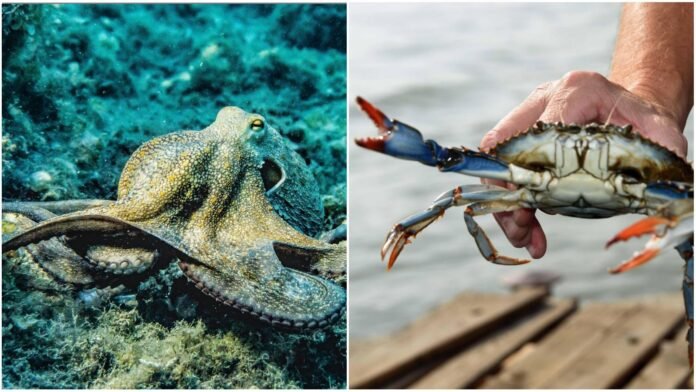


Imagine an army being released into the sea with no weapons, no missiles and no machines—just eight arms and a huge appetite!
Scientists in Italy have launched a remarkable experiment aimed at tackling a growing marine problem: the rapid spread of the blue crab in the Adriatic Sea.
The project, known as Octo-Blu, is being led by researchers at the University of Bologna.
So far, around 80,000 young octopuses have reportedly been released into the Adriatic, with plans to increase the total to around 160,000 by the end of August. The animals are being released while they are still very small, but they can become powerful predators as they grow.
But why octopuses?
The answer is surprisingly simple: blue crabs are natural prey for octopuses.
Researchers hope that restoring larger numbers of octopuses could help create natural pressure on the invasive crab population, which has become a serious problem for fisheries, shellfish farms and marine ecosystems in parts of the Mediterranean.
And here’s the really fascinating part.
According to Scientific American, an adult octopus that survives to maturity could potentially eat up to four blue crabs per day.
That means a successful increase in the octopus population could potentially create a powerful natural predator against the invasive crabs.
But scientists are not claiming that the experiment is guaranteed to work.
The biggest questions are still unanswered: How many of these tiny octopuses will survive? How many will reach adulthood? And will they actually reduce the blue crab population enough to make a meaningful difference?
If the project succeeds, it could become a fascinating example of using nature itself to fight an invasive species, rather than relying only on intensive fishing or other control methods.
So, a strange battle may now be developing beneath the waves:
On one side—an invasive army of blue crabs.
On the other—an army of eight-armed predators.
And scientists are watching closely to see which side wins this extraordinary battle beneath the sea.
If you found this story fascinating, Like and Share the video, and Follow the channel for more amazing science stories.