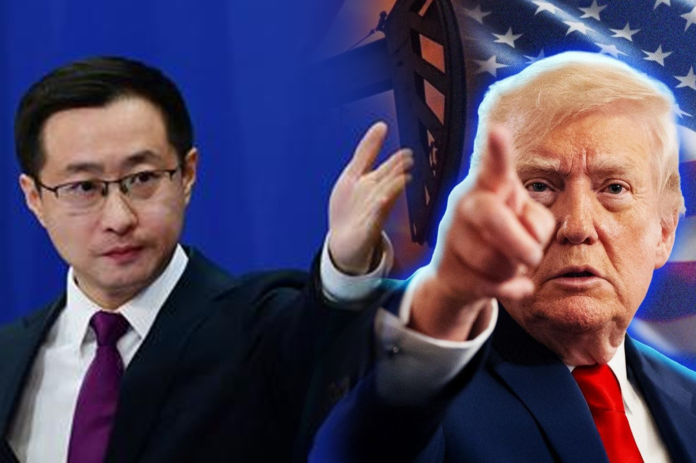
A new and potentially significant development has emerged in the growing economic confrontation between the United States and Iran. After Washington announced tougher sanctions against Tehran and warned that companies and countries doing business with Iran could also face penalties, China has publicly pushed back against the US pressure.
Chinese Foreign Ministry spokesperson Lin Jian said Beijing has repeatedly opposed unilateral and what it considers illegal sanctions. He made it clear that China will take the necessary steps to protect its legitimate rights and economic interests.
The statement comes at a time when Washington is intensifying its campaign to put economic pressure on Iran.
The United States has announced additional sanctions targeting people, companies, shipping networks and other entities connected to Iran’s economy. Washington is also warning foreign businesses that continued dealings with sanctioned Iranian entities could expose them to secondary sanctions.
So why is China reacting so strongly?
The answer is largely connected to energy, trade and China’s strategic interests in the Middle East.
China is one of Iran’s most important economic partners and a major buyer of Iranian oil. Any attempt to severely restrict Iran’s ability to sell oil could therefore affect Chinese companies and China’s energy supply.
There is also the issue of the Strait of Hormuz, one of the world’s most important energy shipping routes. Any major escalation between Iran and the United States that threatens shipping through the Gulf could push global oil prices higher and create additional pressure on economies around the world.
For China, this is not simply an Iran-US dispute. It is also about protecting its access to energy and maintaining stable trade routes.
But there is another important dimension: the broader strategic rivalry between Washington and Beijing.
The United States argues that sanctions are necessary to increase pressure on Iran and restrict its financial and economic networks. China, meanwhile, has repeatedly criticized unilateral sanctions and called for dialogue and diplomatic solutions.
The biggest question now is whether Washington will expand sanctions to major Chinese companies or financial institutions involved in Iranian trade.
If that happens, Chinese businesses could face a difficult choice: continue trading with Iran and risk losing access to parts of the US financial system, or reduce their Iranian operations to avoid American penalties.
This could turn the Iran sanctions issue into a much larger confrontation involving the United States, China, Iran, global oil markets and international trade.
From an analytical perspective, China’s latest statement does not necessarily mean that Beijing is preparing for a direct economic confrontation with Washington. Rather, it is a clear warning that China’s economic and strategic interests cannot simply be ignored while the US increases pressure on Tehran.
If tensions continue to escalate, the consequences could extend far beyond Iran. Higher oil prices, disruptions to shipping, increased inflation and greater uncertainty in global markets could affect countries across Asia and beyond.
The real test now is whether Washington and Beijing can prevent the Iran sanctions dispute from becoming another major front in their broader strategic rivalry.
For now, China has drawn a line: Beijing says it will protect its interests—and the next steps from Washington could determine how far this confrontation goes.