
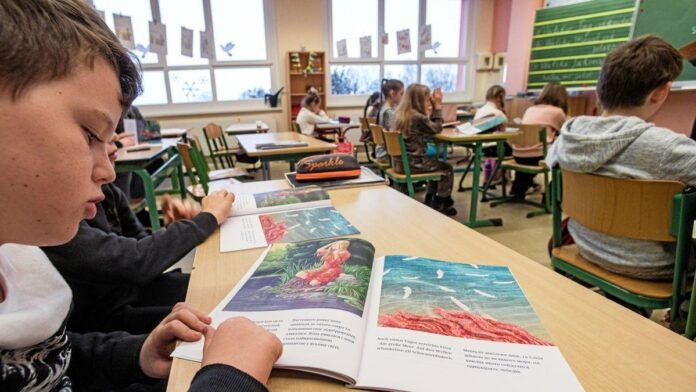
Europe is rethinking the growing use of digital technology in education. Some of the continent’s most advanced education systems are now placing renewed emphasis on physical books, handwriting and traditional classroom learning—particularly for younger children.
Sweden has emerged as one of the most prominent examples of this shift. The Swedish government has moved to limit screen use among younger students and restore a greater role for books, paper and handwriting in classrooms.
Swedish officials argue that in the early years of education, children should primarily focus on developing fundamental skills such as reading, writing and mathematics. Digital devices, they say, should be used when they genuinely contribute to learning rather than simply because technology is available.
Since 2023, Sweden has invested heavily in physical books for schools, with additional funding allocated for books and educational materials in 2026. The government has argued that paper-and-pencil learning environments can be particularly useful for developing children’s concentration, reading and writing skills.
But Sweden is not alone.
In Denmark, a major observational study conducted in 2025 examined screen use through more than 8,000 classroom observations. The findings contributed to a broader discussion about how schools can achieve a better balance between digital and traditional educational resources.
Danish policymakers have also emphasized the importance of maintaining access to physical books while ensuring that digital tools are used where they provide genuine educational value.
France has taken another approach. Since 2025, French schools and colleges have expanded measures requiring students to keep mobile phones away during the school day. From 2026, similar restrictions are being extended to high schools.
French authorities have raised concerns that excessive screen use may affect students’ concentration, health and social development.
Italy has also strengthened restrictions on smartphone use in schools. Since 2025, students have faced broader limits on using personal smartphones during school hours, including restrictions in situations where phones might otherwise be used for educational purposes.
However, the European debate is not really about eliminating technology.
Instead, these countries are trying to answer a more important question: When does technology actually improve learning—and when does it become a distraction?
Denmark’s approach, for example, does not call for completely removing screens from education. Instead, it emphasizes finding an appropriate balance between digital and analogue learning.
Academic research examining Sweden’s experience has also produced a more nuanced picture. Research does not prove that paper books are always superior to digital books. Under certain circumstances, well-designed digital books can also produce strong learning outcomes.
The real issue, therefore, may not be technology itself, but how, when and why it is used.
Age-appropriate technology, effective teaching methods and carefully designed digital resources can all have an important role in modern education. But books, handwriting, direct interaction with teachers, concentration and deep reading remain fundamental skills.
The message coming from Europe is not that education should return completely to the past.
Rather, it is a warning against assuming that making everything digital automatically means making education better.
And this raises an important question for countries such as Pakistan:
As developed education systems reconsider excessive screen use and restore greater emphasis on books and handwriting, should we also ask whether we are simply giving children more screens—or actually giving them a better education?
The future of education may not belong entirely to either books or screens.
It may belong to the right balance between both.