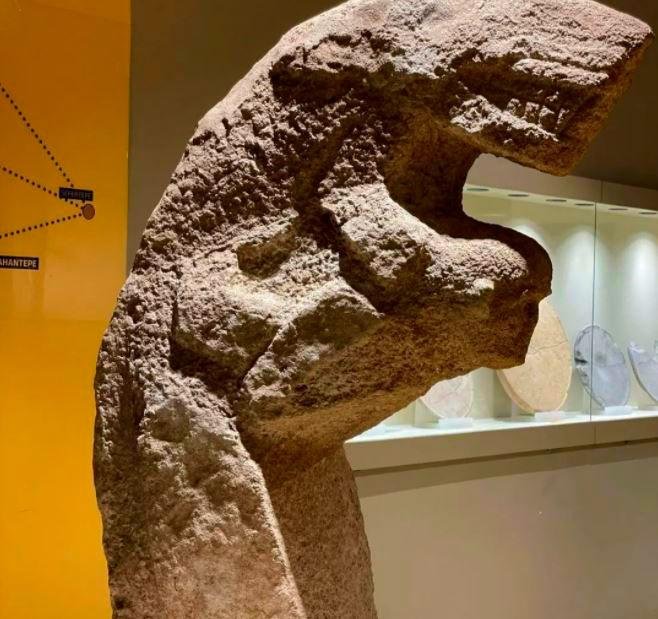


Archaeologists have made a remarkable discovery at Karahan Tepe in southeastern Türkiye — an approximately 11,000-year-old stone sculpture depicting a human figure apparently sitting on the back of a leopard. The unusual statue is being described as one of the most intriguing discoveries from the Neolithic site because archaeologists have not previously encountered a similar human-mounted-animal representation at Karahan Tepe.
The sculpture, measuring roughly 70 centimeters in height, was discovered in situ on a stone bench along the wall of a structure with a paved floor. The structure is approximately three meters wide and appears to have been deliberately constructed and used by the people who inhabited the region thousands of years ago.
Karahan Tepe is part of the Taş Tepeler archaeological region in southeastern Türkiye and is located roughly 22 miles east of the better-known Göbekli Tepe. The area contains numerous monumental structures, stone pillars and sculptures of humans and animals, offering important clues about the beliefs and social life of some of the earliest settled communities.
What makes the newly discovered sculpture particularly fascinating is its unusual composition. Instead of simply depicting an animal or a human figure separately, the ancient artist appears to have deliberately connected the two — showing a person positioned on the back of a leopard.
Interestingly, archaeologists had previously discovered another sculpture at Karahan Tepe showing a human carrying a leopard on their back. The new discovery appears almost like the reverse of that concept: instead of carrying the leopard, the human is positioned above it.
The leopard itself was not an imaginary creature. Leopards lived in the region during the prehistoric period and would have represented a powerful and potentially dangerous predator. For ancient communities, such an animal could have carried meanings associated with strength, danger, authority, protection or the ability to control nature.
However, archaeologists caution against assigning a definite meaning to the sculpture at this stage. There are several possible interpretations. It may have represented power over a dangerous animal, a symbolic confrontation between humans and nature, a ritual or religious concept, or perhaps an idea of transformation and authority. Some researchers may even see similarities with the broader ancient “Master of Animals” motif, in which humans are depicted in close association with powerful creatures.
But these remain interpretations rather than established facts.
Karahan Tepe is particularly important because it dates back to the Pre-Pottery Neolithic period, a time before writing systems existed. This means that researchers cannot simply read an ancient inscription and determine what the sculpture meant. Instead, they have to reconstruct the beliefs and practices of these communities through architecture, sculptures, burial practices and other archaeological evidence.
Excavations at Karahan Tepe began in 2019, and the site has continued to reveal extraordinary examples of prehistoric art. The latest leopard sculpture adds another mysterious piece to that archaeological puzzle.
Perhaps the most fascinating aspect of the discovery is that we can see the image created by people who lived thousands of years before written history — yet we still cannot be certain what message they were trying to communicate.
Was the person riding the leopard a symbol of power? Was the sculpture part of a ritual? Did the leopard represent danger, protection or something supernatural? Or was the scene connected to a story or belief that has completely disappeared from human memory?
For now, archaeologists do not have a definitive answer.
What is certain, however, is that this small stone sculpture has opened a remarkable window into a world that existed around 11,000 years ago — a world in which humans were already creating sophisticated symbolic art and expressing complex ideas through the relationship between people and animals.
More than eleven millennia later, the sculpture has survived — but the ancient message behind it remains a mystery.